


Department of Earth and Atmospheric Sciences
The Earth and Atmospheric Sciences Department at UNC provides students with a unique and rigorous curriculum that prepares them for professional opportunities in the earth science fields.
As an EAS student, you will receive individualized attention from our faculty, who practice the teacher-scholar model whereby students are included in research. We offer our students experiences both in the classroom and beyond.
Located in northern Colorado we are ideally situated for field excursions and campaigns. You may find our faculty and students locally at the Poudre River, chasing storms in neighboring states or investigating volcanoes and weather abroad.
EAS Seminar Announcement:

EAS SEMINAR Announcement:
Supporting Sustainability and Community Climate Resilience with Citizen Science
Rusty Low
Senior Scientist, Institute for Global Environmental Strategies and Lead Scientist for NASA's Global Observer Mosquito Habitat Mapper
April 17, 2024
4:00 pm
(Ross 3240)
For questions or virtual attendance, please email Dr. Bywater-Reyes: sharon.bywaterreyes@unco.edu
Upcoming Events

Find Your Passion
The Earth and Atmospheric Sciences offers four undergraduate program emphasis areas and two graduate programs.

Dedicated Faculty
Earth & Atmospheric Science Faculty are experts who teach — and research — the latest advances in their fields.

In the Field
With Colorado's rich natural resources and range of environments you have access to diverse learning opportunities in Rocky Mountain National Park, the Great Sand Dunes and more.
News and Stories
Our students and faculty are active on campus and in the field. Check out their stories

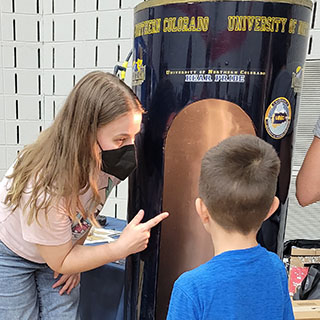

Professor of Brain Storming
For UNC assistant Professor Wendi Flynn, who grew up exploring the Boundary Waters wilderness area in Minnesota and Canada, choosing to study natural sciences was an easy choice. She focused on meteorology and had the opportunity to work on research--which shaped her own philosophy as she became a professor.
She wanted to work closely with students, and Greeley was well-located for studying meteorology with its proximity to the mountains, plains and several great state-of-the-art facilities. That made UNC a perfect choice and she enjoys bringing research and hands-on learning to her students.